Preface
"The act of writing is the act of discovering what you believe." - David Hare
What Got Me Thinking
- A 2022 meta-analysis in Psychotherapy Research found that expressive writing interventions show consistent positive effects on psychological well-being, anxiety, and depression symptoms across dozens of studies - but also flagged high dropout rates in written journaling programs.
- Research from the University of Michigan on self-distancing and emotional processing found that people who narrate their experiences aloud use more reflective, third-person language, which is associated with better emotional regulation.
- The growing body of work on voice biomarkers - how changes in pitch, pace, and tone correlate with mood shifts - suggests that audio journals contain diagnostic information that text journals structurally cannot.
Mental health professionals have recommended journaling for decades. The evidence is real. But there is a gap between what works in theory and what people actually do in practice. Voice journaling closes that gap - and opens a dimension of self-reflection that pen-and-paper journaling never could.
Why Do Most People Quit Journaling?
The short answer: friction. Traditional journaling requires you to sit down, find a quiet moment, open a notebook or app, and translate your inner experience into coherent written sentences. That translation step is where most people stall.
Writing about your emotions is cognitively demanding. You have to feel the feeling, find words for it, organize those words into sentences, and maintain the physical act of writing or typing - all at the same time. When you are already stressed, anxious, or exhausted (which is precisely when journaling would help most), this cognitive load becomes the reason you skip it.
Surveys from mindfulness and therapy apps consistently report that journaling features have some of the lowest sustained engagement rates among all mental health tools. Users start strong in the first week, taper off by week two, and stop entirely within a month. The problem is not motivation. The problem is that the medium - written text - imposes a barrier between having a thought and capturing it.
Voice journaling removes this barrier almost entirely. You speak at roughly 150 words per minute in natural conversation, compared to 40 words per minute typing. But the advantage is not just speed. When you speak, you do not have to translate your emotions into polished prose. You just talk. And that difference is everything.
What Is Voice Journaling for Mental Health?
Voice journaling for mental health is the practice of recording spoken reflections - about your day, your feelings, your challenges, your wins - as a tool for emotional processing and self-awareness. Instead of writing in a notebook, you speak into a microphone. Instead of editing your thoughts into sentences, you let them flow as they come.
The result is a practice that feels more like talking to a trusted friend than filling out a worksheet.
There are several forms this can take:
- Daily check-ins. A 60-second recording at the end of the day: what happened, how you feel about it, what you noticed.
- Emotional processing. Speaking through a difficult experience in real time, narrating what you feel and why.
- Gratitude reflections. Naming three things you are grateful for - out loud, in your own voice.
- Morning intentions. Stating what you want the day to look like before it begins.
- Stream-of-consciousness dumps. No structure, no agenda. Just pressing record and talking until you run out of things to say.
Each of these forms has a slightly different therapeutic function. But they all share the same core mechanism: lowering the barrier between feeling and expression until it is nearly zero.
How Does Voice Journaling Differ from Written Journaling?
The difference is not just about medium. Voice journaling and written journaling engage fundamentally different cognitive and emotional processes.
When you write, you engage your editorial brain. You choose words carefully. You organize thoughts into structures. You unconsciously filter for coherence, which often means filtering out the messy, contradictory, uncomfortable parts of your emotional experience - the parts that matter most therapeutically.
When you speak, you bypass much of that editorial machinery. Thoughts arrive in associative chains. You follow tangents. You contradict yourself mid-sentence and then work through the contradiction in real time. You hear your own voice crack, speed up, slow down, go quiet. That is information. That is data about your inner state that writing can never capture.
Requires structured thinking while emotionally overwhelmed. Filters out messy, contradictory feelings. Loses tone, pace, and vocal emotion. Takes 3-4x longer to produce the same content. Easy to skip when you are tired or stressed.
Flows naturally even when overwhelmed. Preserves raw, unfiltered emotional content. Captures vocal biomarkers - tone, pace, hesitation. 3-4x faster than typing. Low enough friction to do on a walk, in bed, or between meetings.
Researchers at the University of Texas at Austin, building on James Pennebaker's foundational work on expressive writing, have found that the therapeutic benefits of emotional disclosure are not limited to writing. Spoken disclosure produces similar - and in some studies, stronger - effects on emotional regulation and stress reduction. The key ingredient is not the pen or the keyboard. It is the act of putting internal experience into external words.
Voice just makes that act easier.
The Science Behind Speaking Your Feelings
Why does saying something out loud help? Three mechanisms explain most of the therapeutic effect.
Affect Labeling
Neuroscience research, including fMRI studies conducted at UCLA, has demonstrated that the simple act of naming an emotion - saying "I feel anxious" rather than just feeling anxious - reduces activity in the amygdala, the brain's threat-detection center. This effect, known as affect labeling, works even when you do not feel better immediately. The act of naming is itself regulatory.
Voice journaling naturally encourages affect labeling because spoken language tends to be more explicit about emotional states than written language. When you talk through your day, you are more likely to say "that made me angry" or "I feel nervous about tomorrow" than you would be to write those words down. Speaking reduces the self-consciousness that makes people hedge or minimize in writing.
Narrative Construction
When you speak about an experience, you instinctively construct a narrative. You describe what happened, who was involved, how you felt, and what it meant. This narrative construction is a well-documented therapeutic mechanism. It transforms fragmented emotional impressions into a coherent story, which gives your brain a way to file the experience and reduce its emotional charge.
This is, in essence, what talk therapy does. A therapist listens while you narrate your experience, and the narration itself is a significant part of the healing. Voice journaling replicates this process - minus the therapist, but with the same fundamental mechanism.
Self-Distancing
Research from the University of Michigan has shown that when people narrate their experiences, they are more likely to adopt a reflective, observer perspective - what psychologists call self-distancing. This perspective is associated with better emotional regulation, less rumination, and more constructive problem-solving.
Speaking about yourself in a recording creates a natural form of self-distancing. You are both the speaker and the audience. You hear your own words reflected back. This dual role encourages the kind of reflective processing that therapists spend years training their clients to develop.
Voice journaling activates three proven therapeutic mechanisms - affect labeling, narrative construction, and self-distancing - with less cognitive effort than written journaling. You do not need to write well. You just need to talk honestly.
What Does a Voice Journaling Practice Look Like?
The best voice journaling practice is the one you actually do. That said, here is a simple framework to start with.
The Two-Minute Check-In
This is the minimal effective dose. At a consistent time each day - right before bed works for many people, though morning works too - press record and answer three questions:
- What happened today that mattered? Not everything that happened. Just the moments that carried emotional weight.
- How do I feel right now? Name the feeling. Do not explain it or justify it. Just name it.
- What am I carrying into tomorrow? What is unresolved? What are you anticipating?
That is it. Two minutes. No editing, no revision, no performance. Just honest speech.
The Stream-of-Consciousness Dump
When you have more to process - after a difficult conversation, during a stressful period, when something is bothering you but you cannot name what - try an unstructured dump. Press record and talk. No agenda, no framework. Follow your thoughts wherever they go. Give yourself permission to be messy, contradictory, and incomplete.
These recordings are often the most therapeutically valuable, precisely because they capture the raw, unedited shape of your inner experience. You will notice patterns that structured journaling misses. You will hear yourself return to the same themes. You will catch the moment your voice shifts when you touch something important.
Weekly Review
Once a week, listen back to two or three of your recordings. Not all of them - that would be tedious. Just a few. Pay attention to recurring themes, shifts in tone, and the gap between what you said on Monday and how you feel on Friday. This review process turns individual recordings into a longitudinal map of your emotional landscape.
| Practice | Duration | Frequency | Best For |
|---|---|---|---|
| Two-Minute Check-In | 2 minutes | Daily | Building the habit, emotional awareness |
| Stream-of-Consciousness | 5-15 minutes | As needed | Processing difficult experiences |
| Gratitude Recording | 1-2 minutes | Daily | Shifting focus toward the positive |
| Morning Intentions | 1-2 minutes | Daily | Setting emotional tone for the day |
| Weekly Review | 10-15 minutes | Weekly | Identifying patterns and progress |
25 Voice Journaling Prompts to Try This Week
The hardest part of voice journaling is starting. A prompt removes the "I do not know what to say" friction. You press record, read it to yourself, and talk.
Twenty-five prompts in five categories below. None require preparation; each takes two to ten minutes. Start with category one.
Daily Check-Ins (Start Here)
- What is the strongest feeling I am carrying right now, and where in my body do I notice it?
- Describe the last hour of my day in detail. What did I do, who did I see, what stood out?
- If today had a colour, what would it be, and why?
- What is one thing I did today that took courage, however small?
- What did I avoid today that I should not have?
Anxiety and Stress
- Name everything that is on my mind right now. Do not organise. Just list.
- What is the worst-case scenario I am quietly afraid of, and how likely is it actually?
- Is this feeling about today, or is it about something older that today is reminding me of?
- What would I tell a friend who described feeling exactly this way?
- What is one small, concrete thing I can do in the next hour to feel one percent better?
Gratitude and Wins
- Three specific people I am grateful for today, and one thing each of them did that I appreciated.
- The most recent moment when I genuinely laughed. What was happening?
- Something I can do today that the version of me five years ago would have been proud of.
- A skill I did not have a year ago that I have now.
- One thing about my body that worked well today.
Relationships and Conversations
- The conversation I keep replaying: what part of it bothers me, and what would I say now?
- Someone I owe an apology to, or a thank-you, that I have been putting off.
- The last time I felt truly understood by someone. What did they do that made me feel that?
- Where am I performing in my relationships, and where am I being real?
- A boundary I need to set this week, said out loud.
Bigger-Picture Reflection
- What did I believe a year ago that I no longer believe, and what changed my mind?
- If next week was the best week of my year, what would I be doing on Saturday?
- What does my life have a lot of right now, and what does it have too little of?
- What is the question I do not want to ask myself about my life right now? (Ask it.)
- Imagine you are five years older, looking back at this exact week. What advice would future-you give?
A useful pattern: pick one prompt and re-use it daily for a week. By day five the same prompt produces dramatically different recordings, and that delta is itself self-knowledge.
How Do I Start Voice Journaling? A 7-Day Beginner Plan
Most people over-design the practice on day one and quit by day three. The plan below is the smallest version of the habit that still works.
| Day | Practice | Length | Goal |
|---|---|---|---|
| Day 1 | Press record and say "I have never done this before, here is what I think it will feel like". Then talk for three minutes about why you are trying this. | 3 min | Break the awkwardness barrier. |
| Day 2 | Daily check-in (prompt 1 above). Do not listen back. | 2 min | Get comfortable with one-and-done recording. |
| Day 3 | Stream-of-consciousness dump after dinner. No prompt. Just talk until you run out. | 5–10 min | Practice the open-ended form. |
| Day 4 | Pick one prompt from "Anxiety and Stress" or "Relationships" depending on what feels heavier. | 5 min | Practice using prompts as scaffolding. |
| Day 5 | Gratitude recording: three things, in detail. | 3 min | Train the noticing muscle. |
| Day 6 | Listen back to one of this week's recordings. Notice what surprises you. | 5 min listen | Build the reflection loop. |
| Day 7 | Free choice. Pick whichever practice from the week felt most useful and repeat it. | varies | Lock in the practice that fits you. |
By day seven you will know which form (check-ins, dumps, prompts, gratitude, or review) actually moves you. Most people settle on a mix: a quick daily check-in plus one longer weekly session.
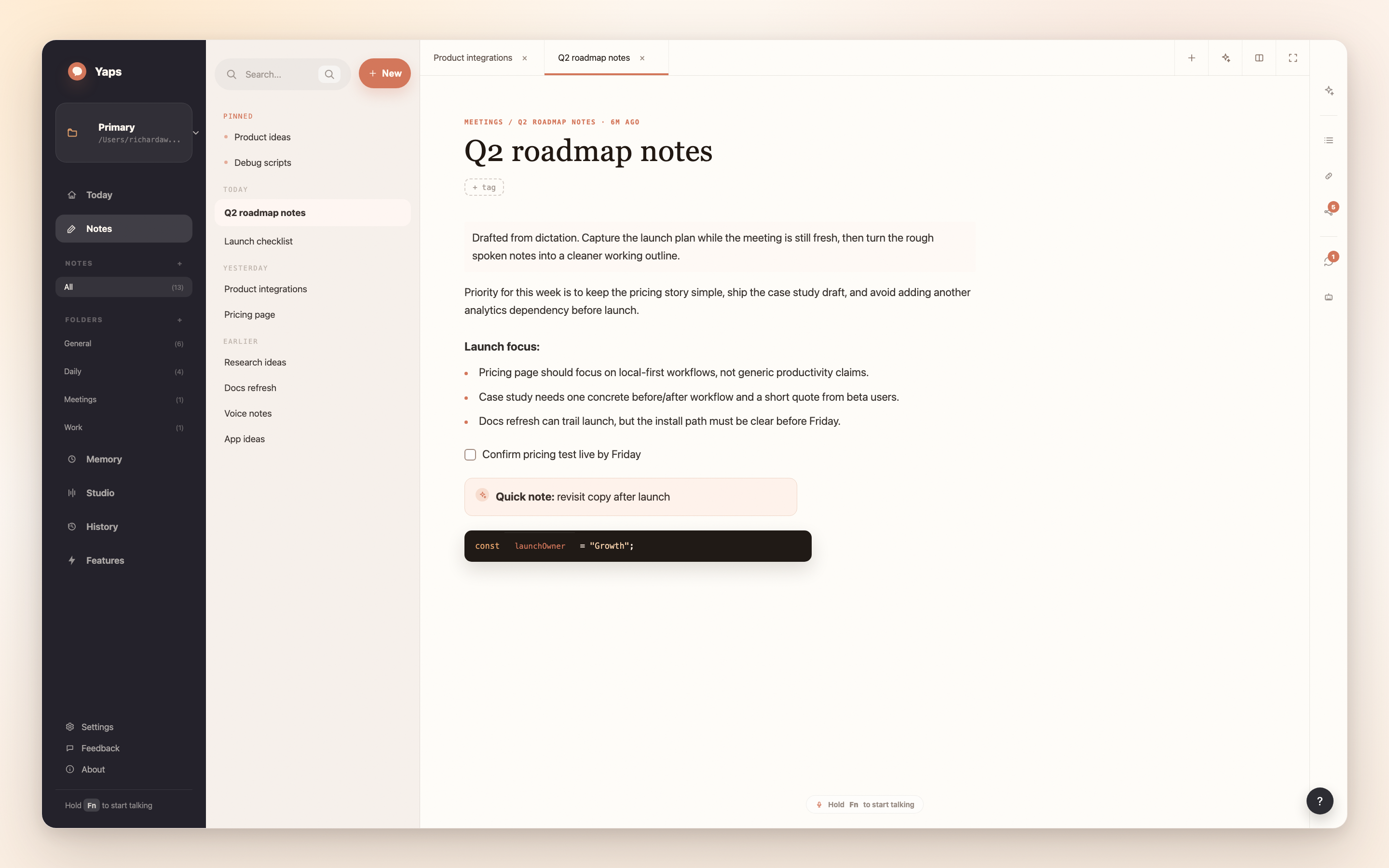
A note on tooling. Voice journaling only works if you can be honest, and honesty requires privacy. Cloud voice apps store your most vulnerable speech on a server you do not control. Use an on-device dictation tool so the entries live only on your machine. Yaps's Quick Notepad (Shift+Fn on Mac) was built for exactly this.
Why Privacy Matters More in Voice Journaling
Here is a truth that does not get discussed enough: the therapeutic value of journaling is directly proportional to how honest you are. And honesty requires safety.
When you journal about your mental health, you are recording your most vulnerable thoughts. Your fears about work. Your frustrations with people you love. Your doubts about yourself. Your unfiltered emotional reactions to the events of your life.
If any part of you suspects that someone - or something - might read, hear, or analyze those words, you will self-censor. You will write (or speak) the version of your feelings that you are comfortable with someone else seeing. And that self-censored version loses most of its therapeutic value.
This is why privacy is not a feature of a voice journaling tool. It is a prerequisite.
Most voice recording apps send your audio to cloud servers for transcription. Your spoken journal entry - the raw, honest, vulnerable one about your marriage, your anxiety, your therapy session - travels over the internet to a data center where it is processed, possibly stored, and potentially used to train AI models. Even if the company's privacy policy says otherwise, the architecture creates risk that your most private thoughts exist on someone else's computer.
On-device processing eliminates this risk at the architectural level. When your voice is transcribed locally - on your own machine, using your own processor - the audio never leaves your device. There is no server to breach. There is no dataset to leak. There is nothing to subpoena. Your journal stays yours.
This is not a theoretical concern. If you have ever hesitated before writing something in a digital journal because you were not sure who might see it, you already understand why privacy in voice data matters more than most people think.
If you are using voice journaling for mental health, verify that your tool processes audio on-device. Cloud-based transcription means your most vulnerable thoughts are transmitted to and stored on external servers - even temporarily. For therapeutic journaling, on-device processing is not a preference. It is a requirement.
Voice Journaling for Specific Mental Health Needs
Voice journaling is not a replacement for professional mental health care. But it is a powerful complement to it - and certain populations benefit disproportionately.
Anxiety
Anxiety thrives in the gap between feeling and understanding. When anxious thoughts loop internally, they intensify. Speaking them aloud externalizes them, which disrupts the loop and makes the thoughts available for rational examination. Many therapists recommend this as a first-line coping technique: say the anxious thought out loud, hear how it sounds, and evaluate it from the outside.
Voice journaling formalizes this technique into a daily practice. Over time, the habit of narrating your anxious thoughts reduces their power. You start to hear the patterns: the catastrophizing, the all-or-nothing framing, the assumptions you are treating as facts. Hearing your own voice say these things creates a natural corrective.
Depression
Depression often involves a narrowing of attention toward negative experiences and away from positive ones. Gratitude-focused voice journaling directly counteracts this attentional bias by requiring you to name - out loud, in your own voice - specific things that went well or that you appreciated.
Depression also saps the energy required for written journaling. Sitting down, opening a notebook, and constructing written sentences can feel impossible when you can barely get out of bed. A voice journal removes that barrier. You can record from bed, from the couch, from wherever you are. Two minutes of spoken words is achievable even on the hardest days.
Burnout and Work Stress
For professionals dealing with chronic work stress, voice journaling serves as a decompression tool. Recording a spoken debrief at the end of the workday - what happened, what was frustrating, what you handled well - creates a psychological boundary between work and personal life. You offload the residue of the day into the recording, and you move on lighter.
This is especially useful for people whose work involves emotional labor: healthcare workers, teachers, managers, caregivers. The practice of narrating your day to yourself, without needing anyone else to listen, provides a form of emotional release that prevents the slow accumulation of unprocessed stress.
ADHD and Neurodivergent Journaling
People with ADHD often struggle with written journaling because the executive function demands - sitting still, organizing thoughts, maintaining a writing habit - are precisely the areas where ADHD creates difficulty. Voice journaling sidesteps these challenges. You can record while walking, while doing dishes, while the thought is still hot. No organization required. No sitting still required.
For more on how voice dictation helps neurodivergent writers and thinkers, the cognitive advantage of speaking over typing is well-documented and especially pronounced for people whose working memory or fine motor skills make writing effortful.
How to Start a Voice Journaling Habit That Lasts
Most journaling habits fail not because of motivation but because of friction. Here are the principles that make voice journaling stick.
Anchor It to an Existing Routine
Do not try to create a new time slot for journaling. Attach it to something you already do every day. Record your check-in while brushing your teeth. Do a stream-of-consciousness dump during your commute. Speak your gratitude reflections while making coffee. The existing routine provides the trigger; the voice journal rides along.
Keep the Bar Absurdly Low
Your minimum viable journal entry is a single sentence. "Today was hard and I do not know why." That counts. That is a journal entry. On days when you have more to say, you will say more. On days when you do not, a single sentence keeps the streak alive.
Do Not Listen Back Immediately
This is counterintuitive, but important. If you listen to every recording immediately after making it, you will start editing yourself in real time. You will perform for the future listener - which is you. Give yourself at least 24 hours before reviewing. This preserves the honesty of the recording.
Use a Tool That Disappears
The best voice journaling tool is one you forget about between recordings. It should not require opening an app, navigating menus, or configuring settings. It should be available the moment you want to speak - a keyboard shortcut, a single button, a hold-and-talk interaction that works anywhere on your Mac. The less you think about the tool, the more you think about what you are saying.
Start with the two-minute check-in at the same time every day for two weeks. Do not aim for insight or breakthroughs. Aim for consistency. The therapeutic benefits of voice journaling compound over time - and the habit of honest self-reflection becomes easier the more you do it.
Can Voice Journaling Replace Therapy?
No. And it should not try to.
Voice journaling is a self-care practice, not a clinical intervention. It complements therapy by giving you a structured way to process experiences between sessions, track your emotional patterns over time, and arrive at your next appointment with clearer language for what you are going through.
Many therapists actively encourage clients to keep some form of journal between sessions. Voice journaling makes this recommendation achievable for people who would otherwise not do it. If your therapist asks you to notice patterns in your anxiety, a collection of voice recordings gives you far richer data than a blank notebook you meant to write in but never did.
For people who are not currently in therapy, voice journaling can serve as a first step toward self-awareness. It is not a substitute for professional support when that support is needed. But it is a meaningful practice on its own - one that builds emotional vocabulary, interrupts rumination, and creates a record of your inner life that you can learn from.
Why Yaps Is Built for Voice Journaling
Yaps was designed around the principle that your voice should stay yours. Every word you speak is processed entirely on your device - on your Mac's Apple Silicon Neural Engine - with no internet connection required. Your journal entries never touch a server, never get stored in a cloud database, never become training data for an AI model.
This is not a privacy policy. It is the architecture. There is no server to breach because there is no server.
Beyond privacy, Yaps is designed for the kind of frictionless interaction that makes daily habits stick. Hold a key and talk. Release the key, and your words are transcribed instantly. No app to open. No menu to navigate. It works in any application on your Mac - a notes app, a dedicated journal, a text file, wherever you want your reflections to live.
Voice notes in Yaps are automatically transcribed and searchable, which means your weekly review becomes simple: search for a theme, a name, a feeling, and find every time you mentioned it. Over weeks and months, this builds into a searchable emotional archive - a map of your inner landscape that you can navigate by keyword.
The app uses under 200MB of RAM, starts in under one second, and runs entirely in your Mac's menu bar. It takes up exactly as much space as it needs - enough to be there when you call, never enough to intrude. Which, if you think about it, is exactly what a good journaling practice should feel like.
Final Thoughts
The therapeutic benefits of journaling are real and well-documented. The problem has never been the evidence. The problem has been the medium.
Written journaling asks you to do something difficult - translate raw emotion into organized text - at the exact moment when difficulty is the last thing you need. Voice journaling removes that demand. It meets you where you are. Tired, stressed, overwhelmed, barely coherent. It does not care. It just listens.
If you have tried journaling before and it did not stick, consider that the failure was not yours. It was the format. Try speaking instead. Two minutes a day, in your own voice, about whatever is on your mind. You might find that the practice you could never maintain in writing becomes effortless when you simply talk.
Start today at yaps.ai.
A voice keyboard that keeps your voice on your phone.
Install Yaps on Android for offline dictation, a familiar full-size keyboard, and no screen capture. Scan the QR on desktop, or tap the Play badge on mobile.
Frequently Asked Questions
Is voice journaling as effective as written journaling for mental health?
Research on expressive disclosure - the therapeutic mechanism behind journaling - shows that spoken expression produces comparable benefits to written expression for emotional regulation and stress reduction. In some studies, spoken disclosure shows stronger effects because it captures richer emotional content and requires less cognitive effort. The best format is the one you will actually do consistently, and voice journaling's lower friction makes it more sustainable for most people.
How long should a voice journal entry be?
There is no minimum or maximum. A single spoken sentence counts as an entry. Most people find that two to five minutes is a natural range for a daily check-in, while stream-of-consciousness processing sessions might run 10 to 15 minutes. The key principle is to keep the bar low enough that you never skip a day because the task feels too large.
Do I need to listen back to my voice journal entries?
Listening back is valuable but not required for every entry. The act of speaking your thoughts aloud provides therapeutic benefit even if you never hear the recording again. That said, a weekly review of two or three entries helps you identify emotional patterns and track changes over time. Think of the recordings as data - the real-time processing helps in the moment, and the review helps over the long term.
Is voice journaling safe if I am discussing sensitive mental health topics?
Safety depends entirely on how your audio is processed. If your voice journaling tool sends audio to cloud servers for transcription, your most private thoughts are transmitted over the internet and stored - even temporarily - on external infrastructure. Tools that process audio entirely on-device, with no internet connection required, eliminate this risk. For mental health journaling, on-device processing is strongly recommended.
Can voice journaling help with anxiety?
Yes. Anxiety often intensifies when thoughts loop internally without external expression. Speaking anxious thoughts aloud externalizes them, which disrupts the rumination cycle and makes them available for rational evaluation. The neuroscience mechanism behind this - affect labeling - has been demonstrated in fMRI studies showing reduced amygdala activity when people name their emotions. Regular voice journaling builds this into a daily habit.
What if I feel self-conscious speaking my thoughts out loud?
This is extremely common, especially at first. Most people feel awkward during their first few voice journal entries. The self-consciousness typically fades within a week of consistent practice. Starting with very short entries - 30 seconds to one minute - helps. Recording in a private space helps. And reminding yourself that no one else will hear these recordings helps most of all. The goal is honesty, not eloquence.
Should I use prompts or just free-form record?
Both approaches work. Prompts (like the three-question check-in: what happened, how do I feel, what am I carrying) provide structure that makes it easier to start. Free-form recording captures more raw, unfiltered content. Many people find that prompts are helpful for building the initial habit, and free-form recording becomes more natural over time as the practice becomes second nature.
Can I use voice journaling alongside therapy?
Absolutely. Many therapists actively encourage journaling between sessions as a way to process experiences, track patterns, and arrive at sessions with clearer language for your emotional state. Voice journals provide richer material than written notes because they capture tone, pacing, and emotional emphasis. Some clients share transcripts of relevant entries with their therapist, which can accelerate the therapeutic process.
How is voice journaling different from just talking to myself?
The key difference is intentionality and capture. When you talk to yourself casually, the words disappear. When you voice journal, you are deliberately creating a record - which changes the quality of your reflection. You tend to be more explicit, more honest, and more structured when you know the words are being preserved. The recording also enables review, which is where long-term pattern recognition happens.
What tools do I need to start voice journaling?
At minimum, you need a device with a microphone and a recording app. For a better experience, look for a tool that transcribes automatically (so your entries are searchable), processes audio on-device (so your entries stay private), and integrates into your existing workflow (so the friction stays low). On macOS, Yaps provides all three - on-device transcription, a system-wide keyboard shortcut, and searchable voice note history - without requiring any configuration.