¿Qué significa ladrar? Definición, origen y por qué es bueno
Ladrar significa hablar mucho. Cada diccionario te dirá eso. Lo que no te dirán es que ladrar pasó cuatrocientos años como un insulto, fue reclamado por Internet en unos cuatro meses y resulta ser la habilidad de productividad más subestimada que ya tienes. Le pusimos el nombre a nuestra empresa. Aquí está la historia completa.
Prefacio
Yapping means talking a lot, usually in a casual, enthusiastic, unfiltered way. Someone who yaps is a yapper. A long, happy stretch of rambling is a yap session. The word can be teasing ("stop yapping"), affectionate ("I love a good yap"), or self-aware ("sorry, I am yapping"), and on most of the internet it has quietly flipped from insult to badge of honour.
That is the short answer, and if you only came for a definition, you now have it.
But almost every page that defines yapping treats it as a flaw to be managed. A bad habit. A thing to apologise for. We think that framing is wrong, and we are unusually qualified to argue the point: we built a voice keyboard, named the company Yaps, and spend our working lives turning people's yapping into finished text. This is the full story of the word, where it came from, why it took over the internet, and why the yappers were right all along.
¿Qué significa ladrar?
Yapping is the act of talking at length, especially in a casual or excitable way. Merriam-Webster defines the verb yap as to talk in a shrill, insistent way, or simply to chatter. Modern usage is broader and warmer than that. When someone on TikTok says they are "in their yapping era", they mean they have a lot to say and they intend to say it.
The word comes in a few forms, and they all pull their weight:
- Yap (verb): to talk a lot. "We yapped for three hours straight."
- Yapper (noun): a person who talks a lot. Increasingly worn with pride.
- Yap session (noun): an extended, low-stakes conversation with no agenda. The natural habitat of the yapper.
- Yapping (the catch-all): the activity itself, as in "bro is yapping again."
There is one nuance worth knowing before you use the word in the wild. Yapping carries two related but distinct senses. The first is about volume: talking a lot, regardless of quality. The second is about substance: talking without saying much, the way "bro is yapping" can mean "he is talking nonsense." Context and tone decide which sense is in play. Said with a grin between friends, it is the volume sense and it is affectionate. Said flatly under a long-winded video, it is the substance sense and it is a critique.
De dónde viene la palabra ladrar
Yap is much older than the internet. According to the Oxford English Dictionary, the word appears in English in the early 1600s, first as a name for a small dog and then as the verb for the sharp, high-pitched bark such dogs produce. If you have ever met a chihuahua with opinions, you already understand the etymology.
By the 1800s, the word had jumped species. People began using yapping to describe human chatter, and the comparison was not flattering: rapid, repetitive, high-pitched noise that the listener wished would stop. Through the twentieth century, "quit your yapping" settled in as a standard way to tell someone to be quiet, and the word picked up an uglier edge along the way. As the Daily Dot notes in its history of the term, "yapping" was disproportionately aimed at women, a catch-all dismissal for any talking a man did not feel like hearing.
That is the four-hundred-year arc in miniature: dog, insult, dismissal. Then the internet got hold of it.
A small dog, then its barkOED
Yap enters English as a noun for a small dog, then becomes the verb for its sharp, high-pitched bark.
Humans start yapping
The word jumps species and becomes a dismissive label for human chatter.
"Quit your yapping"
The insult era. The word becomes a stock way to shut people up, aimed disproportionately at women.
The TikTok reclamationviral
Short-form video revives the word. Yap sessions, yapper baddies, and self-declared yappers turn the insult into an identity.
Badge of honour
Yapping is a personality type, a content genre, and (we would argue) a productivity skill hiding in plain sight.
Cómo los ladridos se apoderaron de Internet
The revival started on TikTok around 2023 and was fully mainstream by early 2024, when Bustle declared yapping the platform's new favourite word. The mechanics of the comeback are almost too neat. TikTok is a platform made of people talking to cameras. It needed a verb for that, and English already had a perfectly good one lying around, slightly dusty, with a funny sound and a dog attached.
Three things turned a dictionary revival into a cultural moment.
Short-form video rewards talkers. The entire grammar of TikTok, Reels, and Shorts is a person speaking quickly and enthusiastically about something they care about. The people who thrive there are, by any historical definition, yappers. Calling the skill by its old insult name was funny, and the joke stuck.
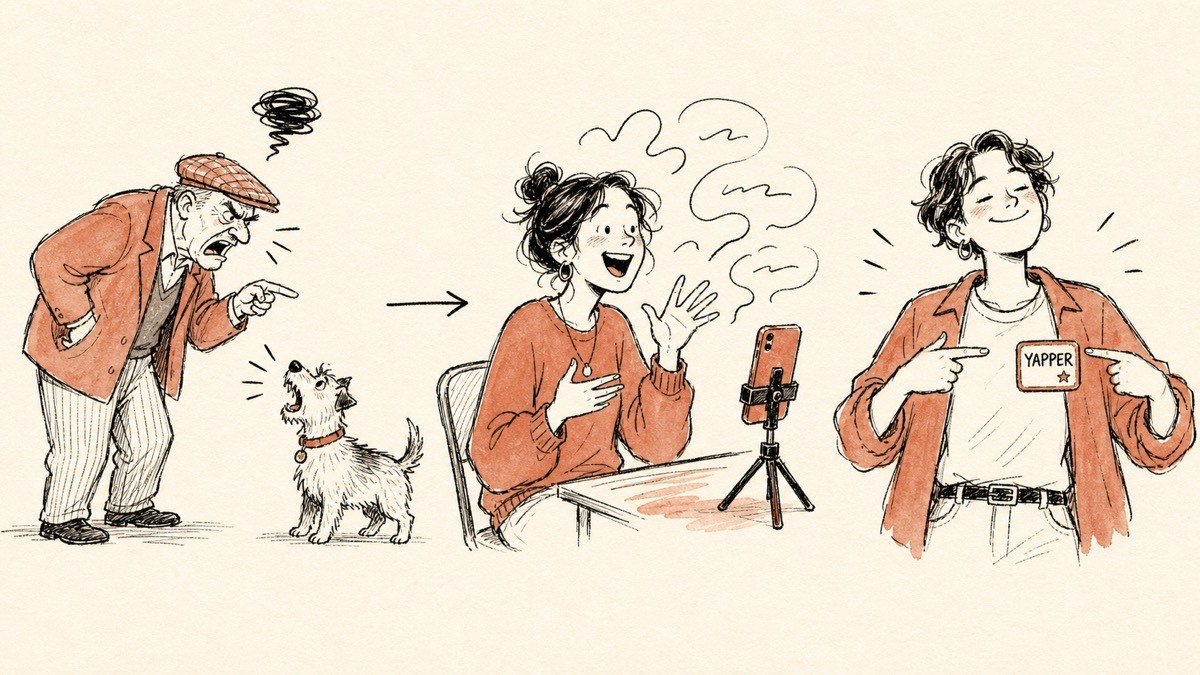
The word got reclaimed, not just revived. This is the part linguists find interesting. For centuries, yapping was a way to dismiss someone, and disproportionately a way to dismiss women. Gen Z picked up the insult and pinned it on like a name badge. Self-described yappers and "yapper baddies" began celebrating the trait the word was designed to shame. Linguists call this semantic reclamation, and it follows the same arc as other once-dismissive labels: the targeted group adopts the word, drains the venom out of it, and wears it.
It filled a real gap. English had no warm word for "talks a lot." Chatty is faint praise. Verbose is an accusation. Talkative is what a teacher writes on a report card before a comma and a complaint. Yapper is affectionate, funny, and specific. Of course it spread.
Yapping was an insult for four hundred years. The internet turned it into a personality type in about four months.
The short history of a long word
By 2026, the word has settled into everyday speech well beyond TikTok. People schedule yap sessions with friends. Podcasts brand themselves as professional yapping. Office workers describe meetings as "forty minutes of yap." The word that once meant "stop talking" now mostly means "this person is fun to listen to."
¿Ladrar es una mala palabra?
No. Yapping is not a swear word, a slur, or anything you would need to censor. It is informal, so you would not put it in a cover letter, but it is safe for general conversation, classrooms, and workplaces.
Whether it is rude depends on how you aim it. Telling a stranger to "stop yapping" is dismissive, the same way it always was. Calling your best friend a certified yapper is a compliment wrapped in a tease. Calling yourself a yapper is the most common usage of all, and it is pure self-aware affection. The word has not lost its teeth entirely; it has just stopped biting by default.
The old sense
Yapping as a dismissal
"Quit your yapping." Aimed at someone else, flatly, it still means their words are noise. This is the four-hundred-year-old insult, and it survives in phrases like "bro is yapping," which questions the substance of what someone says, not just the amount.
The new sense
Yapping as an identity
"I am such a yapper." Claimed for yourself or offered to a friend, it celebrates enthusiasm, openness, and the ability to fill a silence well. This is the dominant sense online, and it is warm by default.
If you are ever unsure which way the word will land, the rule is simple: yapping aimed at someone is a tease, yapping claimed for yourself is charm.
El caso de los ladridos
Here is where this article stops being a dictionary entry and starts being an argument.
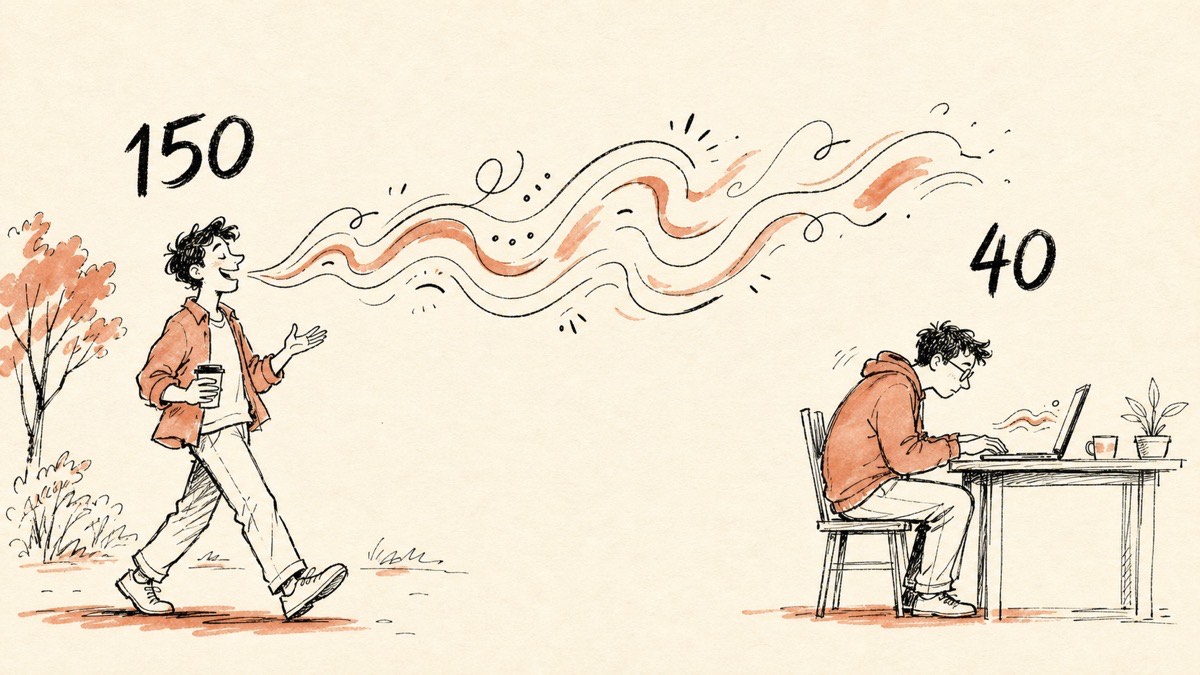
The internet reclaimed yapping as a joke, but underneath the joke sits a fact that almost nobody says out loud: talking is the highest-bandwidth output a human being has. Most people speak at around 150 words per minute in normal conversation. Most people type at around 40. The gap is not small. It is nearly four to one, and it has been sitting there your whole life.
The numbers get better. A University of Arizona study published in Science recorded people's daily speech and found that the average person speaks around 16,000 words a day. Sixteen thousand words is roughly sixty pages of a paperback. You produce a short book of spoken language every single day, and almost all of it evaporates the moment it leaves your mouth.
What do yappers actually do better? They think out loud. Psychologists have a name for this: verbal processing, the tendency to work out what you think by saying it. If you have ever solved a problem by explaining it to a colleague, a friend, or a rubber duck, you have used it. The rambling is not a detour around the thinking. The rambling is the thinking. Yappers simply run this loop more often and with less embarrassment than everyone else.
They also draft faster than anyone realises. Ask a self-described yapper to write about their favourite topic and you get a blank page and a sigh. Ask them to talk about it and you get ten structured minutes with examples, tangents that turn out to be relevant, and a strong opinion for a conclusion. That is a first draft. It just happens to be made of air.
For four hundred years, the word yapping framed all of this as a defect. The reframe the internet stumbled into is more accurate: fluent, enthusiastic, high-volume talking is a skill. The only genuine problem with yapping was never the yapping. It was that nothing useful happened to the words afterwards.
That problem now has a fix.
Cómo convertir los ladridos en un trabajo real
There is a reason we named our product Yaps.
Yaps is a voice keyboard and dictation app for Android, macOS, Windows, and Linux. You talk, and clean text appears in whatever app you are using: messages, email, notes, documents, anything with a text field. On Android, you tap the dictation button on the Yaps keyboard. On a Mac or PC, you push the Yaps hotkey and start talking. The speech recognition runs on your device, which means your yapping is transcribed privately, works without an internet connection, and never sits on someone else's server.
The deeper point is what this does to the maths from the last section. If you speak at 150 words per minute and type at 40, then every message, email, and note you currently type is running at roughly a quarter of your natural output speed. Dictation does not ask you to become a different kind of person. It asks you to do the thing yappers were born doing, at the speed they already do it, and it handles the part where the words become text.
In practice, the yap-to-text workflow looks like this:
The walk-and-yap loop. You take a walk, an idea shows up, and instead of losing it you talk it into a voice note. Sixty seconds of rambling becomes a captured, searchable thought. The shower-thought graveyard finally closes.
The message-yap loop. The reply you have been putting off all day takes ninety seconds when you say it instead of typing it. Long messages stop being a chore because the length no longer costs you anything.
The brain-dump loop. Before a meeting, an essay, or a difficult decision, you yap at your phone for five minutes with no structure at all. Then you read it back. Somewhere in the transcript, you have already said what you actually think. This is verbal processing with a save button, and it is the closest thing to a cheat code that journaling and planning have.
Two honest caveats. Yaps supports 20+ mobile keyboard and voice-typing languages, but people who need very broad multilingual transcription catalogs may still want a specialist tool. And the optional cloud features (like premium voices) do use the internet; the core dictation does not. Everything else about the pitch is exactly as simple as it sounds: you already produce 16,000 words a day. Yaps is how some of them survive.
If you want to get better at the craft itself, we wrote a full guide on how to get good at voice typing, and a deeper piece on capturing ideas with voice notes before they evaporate.
Cómo utilizar ladridos en una oración
A quick field guide, because tone is everything with this word:
- Affectionate: "We got coffee and yapped for three hours. Best day of the week."
- Self-aware: "Sorry for the voice note, I was yapping."
- Proud: "I am a yapper. It is genetic. My mum can talk for England."
- Teasing: "You have been yapping about this show for twenty minutes and I still do not know what it is about."
- Critical (the nonsense sense): "He said the meeting was important. He was yapping."
And the wider yap vocabulary, since the word has grown a whole family:
| Term | What it means | Tone |
|---|---|---|
| Yap | To talk a lot; also the talking itself ("that was quality yap") | Playful |
| Yapper | A person who talks a lot, usually said with affection or pride | Affectionate |
| Yap session | A long, agenda-free conversation between friends | Warm |
| Yapping era | A period of your life in which you have a lot to say and say it | Proud |
| Yapaholic | A yapper of unusual commitment; the superlative form | Teasing |
| "Bro is yapping" | This person is talking a lot without saying much | Critical |
Pensamientos finales
Words carry verdicts, and for four centuries the verdict inside yapping was "your talking is noise." The internet overturned that verdict, mostly as a joke, and the joke turned out to be correct. Talking a lot, fluently and enthusiastically, is not a flaw. It is the fastest interface you own, and the only thing it ever lacked was somewhere for the words to go.
So define yapping however you like: talking a lot, talking casually, talking with joy. Then notice that every definition describes something you can already do at 150 words per minute. If you are a yapper, you are not too much. You are sitting on a skill, and Yaps was built to put it to work. The yappers were right all along. It just took the dictionary four hundred years to catch up.
Preguntas frecuentes
What does yapping mean in slang?
Yapping means talking a lot, usually in a casual, enthusiastic, or unfiltered way. In modern slang it is mostly playful: someone "yapping" is chatting at length, and a "yapper" is a person known for it. Depending on tone, it can also imply someone is talking without saying much.
Is yapping a bad word?
No. Yapping is not a swear word or a slur, and it is safe to use in everyday conversation. It is informal, and it can be rude if aimed dismissively at someone ("stop yapping"), but among friends and online it is usually affectionate or self-deprecating.
What does yapper mean?
A yapper is a person who talks a lot. Online, the label is usually worn with pride: people describe themselves as yappers to signal that they are chatty, enthusiastic, and good company. It can still be a light tease when applied to someone else.
Where does the word yap come from?
Yap entered English in the early 1600s, first as a word for a small dog and then for its sharp, high-pitched bark, according to the Oxford English Dictionary. By the 1800s, it was being applied to human chatter, and it spent most of the twentieth century as the insult in "quit your yapping."
What is a yap session?
A yap session is a long, low-stakes conversation with no agenda, usually between friends. The term is affectionate and treats extended chatting as a pastime worth scheduling, not a habit to apologise for.
Does yapping mean lying or talking nonsense?
Sometimes. In phrases like "bro is yapping," the word means someone is talking a lot without substance, which can shade into talking rubbish. This is the critical sense of the word. It questions the quality of what is said, not just the quantity. Context and tone make the meaning clear.
Why is everyone saying yapping now?
The word went viral on TikTok around 2023 and was mainstream by 2024. Short-form video platforms are built on people talking to cameras, so an old verb for enthusiastic talking found a perfect new home. Creators began celebrating "yap sessions" and calling themselves yappers, and the usage spread into everyday speech.
Is being called a yapper a compliment or an insult?
Usually a compliment, or at worst a friendly tease. The word historically mocked people for talking too much, but Gen Z reclaimed it, and self-identifying as a yapper is now common. Tone decides everything: warm delivery means affection, flat delivery means criticism.
What is a yapper baddie?
A yapper baddie is a TikTok-era label for someone, typically a woman, who is both stylish and an unapologetic talker. The phrase is part of the broader reclamation of yapping: traits that were once mocked are claimed as part of an attractive, confident identity.
What is the difference between yapping and oversharing?
Yapping is about volume and enthusiasm; oversharing is about content. A yapper talks a lot, possibly about anything. An oversharer reveals things the audience did not need to know. You can yap for an hour without oversharing once, and you can overshare in a single sentence.
How do I stop yapping so much?
You may not need to. If your talking annoys people in specific settings, the fix is usually reading the room, not becoming quieter everywhere. A better question is where to put the energy: many natural talkers channel it into voice notes, dictated journals, and drafts, where the volume becomes an asset instead of a social risk.
Can yapping be productive?
Yes, and dramatically so. People speak at roughly 150 words per minute and type at roughly 40, so talking is the fastest way most people can produce words. With a dictation app like Yaps, rambling out loud becomes clean text in any app, which turns a yap into a draft, a note, or a finished message.
What does yapping mean in text messages?
In texts and comments, yapping usually refers to someone writing or talking at length: "sorry for yapping" under a long message, or "the yapping is crazy" under a long video. It is the same word with the same playful tone, applied to any stream of words, typed or spoken.
What do you call someone who loves to yap?
A yapper, a yapaholic if they are committed, or someone "in their yapping era." Pre-internet English offered chatterbox, motormouth, and windbag, but none of them carry the affection that yapper does in 2026.
Is yapping good for your brain?
Talking through your thoughts genuinely helps you think. Psychologists call it verbal processing: explaining a problem out loud forces you to structure it, which is why people solve problems mid-explanation. Yapping into a voice note or dictation app captures that thinking instead of letting it evaporate.