Is AI-dictatie daadwerkelijk nauwkeurig? De eerlijke foutenpercentage-wiskunde
Elke dicteer-app claimt een nauwkeurigheid van 95 tot 99 procent. Dat klinkt geweldig totdat je de rekensom maakt: 95 procent betekent nog steeds dat ongeveer één op de twintig woorden fout is, of ongeveer 25 correcties in een e-mail van 500 woorden. Dit is wat dicteernauwkeurigheid werkelijk is, waar het eigenlijk van afhangt, hoe u uw eigen nummer kunt meten en waar een tool op het apparaat zoals Yaps past, eerlijk gezegd.
Voorwoord
Every voice-typing app on your phone promises the same thing: 95 percent accuracy, or 98, or 99. Those numbers are technically real. They are also close to meaningless on their own, because 95 percent accuracy means one word in twenty comes out wrong. Over a 500-word email that is about 25 words to fix by hand. Even a genuinely excellent 98 percent still leaves you roughly 10 corrections on that same email.
So is AI dictation accurate? The honest answer is: more accurate than it has ever been, and never 100 percent. The headline percentage a vendor prints is a lab number measured in conditions that are not your desk, your accent, your microphone, or your noisy kitchen. This is the evaluative explainer. We are going to do the arithmetic the marketing skips, break down what accuracy actually depends on, show you how to measure your own real-world error rate, and place Yaps in that picture honestly. If you want the practical how-to for pushing your own number higher, that lives in our dictation accuracy tips guide, and we will point you there rather than repeat it.
Wat dicteernauwkeurigheid eigenlijk betekent
Before you can judge any accuracy claim, you need to know what is being measured. The standard metric is Word Error Rate, or WER, and it is worth understanding because it is the number underneath every marketing percentage.
Word Error Rate is the share of words a system gets wrong. WER equals substitutions plus deletions plus insertions, divided by the number of words you actually spoke.
The formula is simpler than it looks. Take a reference passage of known words. Run it through dictation. Then count three kinds of mistakes: substitutions (it heard "their" for "there"), deletions (it dropped a word entirely), and insertions (it added a word you never said). Add those up and divide by the total number of reference words.
Here is a worked example. You speak 100 words. The system makes 5 substitutions, 2 deletions, and 3 insertions. That is 10 errors over 100 words, so your WER is 10 percent, and your accuracy is 90 percent. Accuracy is always 100 percent minus WER. One quirk worth knowing: WER can exceed 100 percent. If a system hallucinates and inserts more wrong words than you spoke, the error count can be larger than the word count. Accuracy is not a comfortable, bounded thing.
This is why a single percentage is a weak way to describe a dictation engine. It compresses five kinds of behaviour into one figure, and it says nothing about the conditions the figure was measured in. We break the whole recognition pipeline down in the technology behind speech recognition if you want to see what is happening between your voice and the text.
De benchmarkcijfers, met het eerlijke sterretje
Modern speech models are genuinely good. In clean, studio-quality conditions on scripted read speech, the best models sit around 3 to 5 percent WER, closing in on the human transcription benchmark of roughly 2.5 percent. Widely-cited lab figures put the strongest open models near 2.5 to 2.7 percent WER on clean read speech, with smaller variants of the same family around 5 to 8 percent, and the big cloud APIs in the low single digits.
Here is the asterisk that most benchmark posts bury. Those numbers are measured on clean, read speech in quiet rooms. The same model that scores about 2.5 percent WER on studio read speech drops to roughly 8 to 12 percent WER on real, conversational English at a normal desk. Same engine. Different conditions. So a "99 percent accurate" headline and your lived experience of "this gets about one word in ten wrong" can both be true at once. The gap is not necessarily marketing dishonesty. It is the difference between a lab and your life, and any honest accuracy discussion has to state both numbers together.
Waar nauwkeurigheid eigenlijk van afhangt
Accuracy is not one number. It is the product of five variables, and any of them can move your result by more than the difference between two "competing" apps. Here are the five, each with a concrete figure.
The Model And Engine
The recognizer itself sets the ceiling. A large, modern model trained on diverse speech will beat an older or heavily compressed one, all else equal. This is the variable the vendor is really advertising when they quote a percentage, and it is the one you have the least direct control over. It also matters less than people assume once the other four variables are bad, because a great model in a noisy room with a weak mic still produces a poor transcript.
Your Accent
Speech models are trained on data, and most are optimised around standard US and British English. If you speak with a strong regional or non-native accent, your WER can climb above 20 percent on systems that score in the low single digits for the accents they were tuned on. This is not a flaw in your speech. It is a coverage gap in the training data, and it is one of the largest single drivers of a bad dictation experience. Does an accent make dictation less accurate? Measurably, yes, and it is the reason two people can use the same app and rate it completely differently.
The Microphone
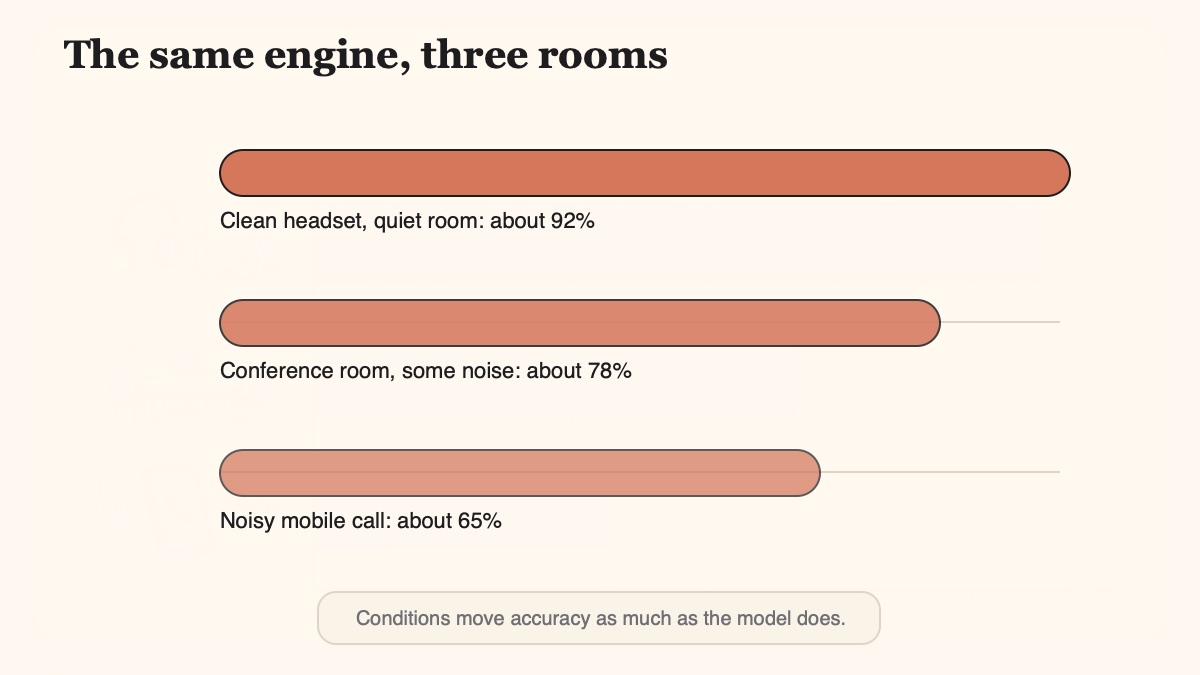
The microphone and where you place it are measurable, not vibes. The same speech API has been measured at 92 percent accuracy on a clean headset, 78 percent in a conference room, and 65 percent on a mobile call with background noise. That is a 27-point swing from one variable. A close, decent microphone is often the cheapest accuracy upgrade available, and it is entirely in your hands.
Background Noise
Noise degrades recognition in a predictable way. Even moderate office noise in the 50 to 60 decibel range costs roughly 5 to 7 percentage points of accuracy. Push past about 65 decibels, stack an accent and some technical vocabulary on top, and you can lose 5 to 15 points off your baseline. The flip side is good news: moving to a quiet room and a close mic can recover 8 to 15 points, which is why "why is my dictation so inaccurate" often has a very physical answer.
Domain Vocabulary
Jargon, product names, drug names, acronyms, and unusual proper nouns are the hardest thing for any recognizer, because it cannot spell a word it has never learned. A model that transcribes everyday speech near-perfectly will still stumble on your colleague's surname or your industry's abbreviations. This is a real limit, and no amount of post-processing fully solves a fundamental mis-hear of a rare name.
Cloud versus on-device: de nauwkeurigheidsas die niemand uitlegt
There is one more variable that sits underneath all five above, and it is the one vendors rarely discuss: where the recognition actually runs. This matters most on Android, where voice typing is the default way most people dictate.
Cloud dictation runs a large model on a remote server with effectively no size limit, so its raw ceiling can be higher. But that ceiling comes with strings. Cloud accuracy varies with your network quality, server load, and how the streaming session behaves, so the same app can feel sharp one minute and mangle a sentence the next. And every word of audio leaves your device to get there.
On-device dictation runs the model on your phone or computer. It is constrained by file size and memory, so a naive on-device model can trail a giant server model on raw ceiling. What it gives you in return is consistency. There is no network variance, no server load, no connection to drop mid-sentence, and the audio never leaves the device.
Why The Offline Pack Of The Same App Is Often Worse
Here is the mechanism, using a concrete example. When you install the offline language pack for Google's Gboard, you are downloading a heavily compressed version of the recognizer. Gboard's offline model has at times been as small as around 80 megabytes, down from server-era models measured in hundreds of megabytes to a couple of gigabytes, and there is even a tiny "small" variant around 12 megabytes. Fewer megabytes means fewer parameters, and fewer parameters trades some accuracy for the ability to run locally without eating your storage and RAM. Newer offline models narrow this gap considerably, but the size-versus-accuracy tradeoff is inherent. That is why the offline mode of an app can feel a notch behind its online mode: they are literally different-sized models.
The De-Googled Route, Named Honestly
On most Android phones (Samsung, OnePlus, Motorola, Pixel), Gboard voice typing routes your audio to Google's servers by default unless you install and enable the offline pack. If keeping audio on the device is your goal, there are genuinely open-source options worth naming: FUTO Voice Input is an offline-first, on-device recognizer, and it pairs with HeliBoard, an open-source keyboard (an OpenBoard fork) that has no built-in dictation of its own. That combination is GrapheneOS-compatible and keeps your voice on the phone. Those FOSS tools are more fully open-source than Yaps, and it would be dishonest not to say so. We cover that setup in more depth in our private voice keyboard for Android guide.
- Higher raw ceiling from a huge server-side model with no size limit
- Accuracy swings with network quality, server load, and streaming behaviour
- Every word of audio leaves your device to reach the server
- Fails or stalls without a stable connection
- A compressed model, so a naive one can trail on raw ceiling
- No network variance, so the result is consistent every time
- Audio never leaves the phone or computer
- Works on a plane, a basement, or an air-gapped network
Hoe u uw eigen woordfoutenpercentage kunt meten
Vendor numbers are their conditions. The only accuracy that matters is yours, and you can measure it in about five minutes. This is a measurement test, not an accuracy-improvement guide; for the tuning tips, see dictation accuracy tips and how to get good at voice typing.
Pick a fixed reference passage~150 words
Choose a passage of about 100 to 200 words you know exactly, and count the words. A paragraph from an email you already sent works well.
Dictate it in your real roomReal mic
Read the passage aloud once at your normal pace, with your real microphone, in the room where you actually work. Do not stage a quiet studio.
Line the output up against itCompare
Paste the dictated result next to your reference so you can read them side by side, word for word.
Count S, D, and IErrors
Count wrong words (substitutions), dropped words (deletions), and added words (insertions). Add them for your total error count.
Divide by the word countYour WER
Divide total errors by the reference word count and multiply by 100. Repeat quiet versus noisy, and built-in mic versus headset, to see which variable moves your number most.
Free WER calculators (search for one, several transcription vendors host them) automate the diff so you do not have to count by hand. The point of the test is not one number. It is finding out which of the five variables is costing you the most, because that tells you what to fix.
Is 95 procent eigenlijk slecht? Een eerlijke vergelijking
It is easy to read all of this as an indictment of dictation. It is not. The fair question is not "is dictation perfect" but "is dictation better than the keyboard it replaces," and the answer is often yes.
Human typing is not 100 percent either. Cited averages put typing accuracy at roughly 92 to 96 percent, meaning even proficient typists err on 4 to 8 percent of keystrokes before autocorrect cleans up after them. One Stanford study found speech recognition had roughly a 20 percent lower error rate than typing for English (and a larger gap for Mandarin), with dictated notes averaging around 1.5 errors against 2.9 for typed ones. In other words, a "95 percent accurate" dictation system can already beat the keyboard you are comparing it to. The goal was never zero corrections. It is fewer corrections than the alternative, produced faster, with your hands free.
The right question is not whether dictation is perfect. It is whether it produces fewer corrections than the keyboard it replaces. Increasingly, it does.
Waar Yaps past, eerlijk gezegd
Yaps is built for the consistency side of the accuracy question rather than a fragile lab-record ceiling. Dictation runs on-device, on your Android phone (using the dictation button on the Yaps keyboard), and on your Windows or Mac computer (push the Yaps hotkey). Because recognition happens on the device, there is no cloud-quality variance from network wobble or server load, and your audio never leaves the device. The number you measure on Monday is the number you get on Friday.
Two more things move your usable accuracy. First, Yaps dictation is multilingual with auto-detection across about 25 languages, so it recognises the language from your speech instead of making you flip a setting, which removes one common source of mismatched-language errors. Second, Yaps runs an on-device text-cleanup layer after transcription. It strips filler words like "um" and "uh," fixes punctuation and capitalisation, and untangles rambling into clean sentences. That raises the usable, ready-to-send accuracy above the raw WER of the recognizer, because most of what makes raw dictation look bad is fluency and formatting, not fundamental mis-hears.
Now the honest concessions, because the whole point of this post is not out-marketing the marketers. No dictation engine is 100 percent, and Yaps is no exception. On-device accuracy still depends on your microphone, your accent, and your background noise, exactly like every other tool here. The cleanup layer fixes fluency and formatting, but it cannot invent the correct spelling of a rare proper noun it never heard clearly. And if fully open-source is your hard requirement on Android, the FUTO Voice Input and HeliBoard combination is more open than Yaps. Yaps's honest wedge is consistency, privacy, breadth, and no setup, not a claim to the highest raw ceiling on Earth.
If you want to see the full dictation surface, the Yaps dictation feature page covers it, and the offline dictation guide and our guide to accurate offline speech-to-text on Android go deeper on the on-device and no-internet angle.
Veelgestelde vragen
Is AI dictation accurate?
AI dictation is accurate enough to beat typing for most people, but it is never 100 percent. The best models hit 3 to 5 percent word error rate in clean lab conditions, which rises to roughly 8 to 12 percent on real conversational speech at a normal desk. That means a few corrections per few hundred words. Accuracy depends heavily on your model, accent, microphone, background noise, and vocabulary, not on the marketing percentage alone.
How accurate is voice typing in 2026?
In 2026, voice typing on a good model reaches roughly 95 to 97 percent accuracy on clear speech in a quiet room, and lower in noise or with a strong accent. Top engines approach the human transcription benchmark of about 2.5 percent error in ideal lab conditions, but real-world use commonly lands nearer 90 percent. It is the most accurate it has ever been, and still not perfect.
What is a good word error rate for dictation?
A good real-world word error rate for dictation is around 5 percent or lower, meaning roughly one word in twenty needs fixing. Lab benchmarks of 2.5 to 5 percent are best cases on clean read speech; at a normal desk, anything under about 10 percent is workable. Below 5 percent, dictation is usually faster than typing even after you correct the mistakes.
What does 95 percent dictation accuracy actually mean in corrections?
95 percent accuracy means a 5 percent error rate, or one word in twenty coming out wrong. Over a 500-word email that is about 25 corrections by hand; over a 5,000-word document it is roughly 250. Even 98 percent accuracy still leaves about 10 fixes per 500 words. The percentage sounds better than the correction count feels, which is why the raw number can mislead.
Is voice typing more accurate than typing on a keyboard?
Voice typing is often more accurate than typing. Human typing accuracy averages around 92 to 96 percent, and one Stanford study found speech recognition had roughly a 20 percent lower error rate than typing for English, with dictated notes averaging fewer errors than typed ones. The realistic goal is fewer corrections than the keyboard, produced faster and hands-free, not zero corrections.
Why is my dictation so inaccurate?
Poor dictation almost always traces to one of five things: a weaker model, your accent falling outside the training data, a low-quality or distant microphone, background noise, or specialised vocabulary the model never learned. Microphone and noise are the fastest fixes; a close, decent mic in a quiet room can recover 8 to 15 accuracy points. Run the five-step word-error-rate test to find your worst variable.
Does an accent make dictation less accurate?
Yes, an accent measurably reduces dictation accuracy, because most models are optimised around standard US and British English. A strong regional or non-native accent can push word error rate above 20 percent on systems that score in the low single digits for the accents they were tuned on. This is a training-data coverage gap, not a flaw in your speech, and it is one of the biggest single drivers of a poor experience.
Why is offline voice typing less accurate than online?
Offline voice typing is usually a bit less accurate because the on-device model is a heavily compressed version of the online one. Google's Gboard offline recognizer has been as small as around 80 megabytes, down from server models measured in hundreds of megabytes to gigabytes, with even a tiny 12-megabyte variant. Fewer megabytes means fewer parameters, which trades some accuracy for running locally. Newer offline models narrow the gap, but the tradeoff is inherent.
Is on-device dictation as accurate as cloud dictation?
On-device dictation can trail cloud dictation on raw ceiling because it uses a smaller, compressed model, but it wins on consistency. There is no network variance, no server load, and no dropped connection, so your accuracy is the same every time, and your audio never leaves the device. For most everyday dictation the difference in raw accuracy is small, and the consistency and privacy often matter more than the last point or two of ceiling.
Does the microphone affect dictation accuracy?
The microphone strongly affects dictation accuracy. The same speech API measured 92 percent accuracy on a clean headset, 78 percent in a conference room, and 65 percent on a mobile call with background noise, a 27-point swing from mic and placement alone. A close, decent microphone is often the single cheapest accuracy upgrade you can make, and it is entirely within your control.
How much does background noise reduce dictation accuracy?
Background noise reduces dictation accuracy in a predictable way. Even moderate office noise around 50 to 60 decibels costs roughly 5 to 7 percentage points of accuracy, and noise above about 65 decibels combined with an accent and technical vocabulary can cut 5 to 15 points off your baseline. Moving to a quiet room and a closer microphone can recover 8 to 15 points.
How do I measure my own dictation word error rate?
To measure your own word error rate, pick a fixed passage of 100 to 200 known words, dictate it once in your real environment with your real microphone, then compare the output to the reference. Count substitutions, deletions, and insertions, add them up, divide by the reference word count, and multiply by 100. Repeat quiet versus noisy and built-in mic versus headset to see which variable moves your number most.
Laatste gedachten
Is AI dictation accurate? Yes, more than at any point in its history, and no engine is 100 percent. The 95 to 99 percent figures on the marketing pages are real lab numbers measured in conditions that are not your desk, and the honest way to read them is as a best case, not an average. Your actual accuracy is set by five things you can measure and mostly control: the model, your accent, your microphone, your noise, and your vocabulary. Run the five-step test, find your worst variable, and fix that one.
When you want dictation that is consistent rather than merely impressive on a lab bench, Yaps is our honest default. It runs on-device so there is no cloud-quality variance and your audio never leaves the phone or computer, it auto-detects about 25 languages, and its on-device cleanup layer raises the usable accuracy by fixing filler and punctuation. It is not magic, and it is not the only private option on Android. But for most people who want fewer corrections without sending their voice to a server, it is the tool that gets out of the way. Start free, run the test, and trust your own number over anyone's headline.