
Préface
Care notes are written in the worst possible conditions.
You are in a car outside somebody's house. You have ten minutes before the next call, or you have already lost them because the last visit ran over. The details you need to record are specific and they matter: what you did, what changed, what worried you, whether the person ate. And you are typing it with your thumbs on a phone that has one bar of signal.
So the notes get short. Not through carelessness, but because the conditions are hostile and there are six more visits today. And short notes are the ones that fail the person you are supporting, because the small change you did not have time to write down is the one that mattered three weeks later.
Speaking the note takes ninety seconds. This guide covers doing that on a phone, on the device, without needing a signal or sending anything about the person to a server.
Qu'est-ce que c'est et ce n'est pas
Being clear up front, because this sector is full of software that claims more than it does and the consequences land on vulnerable people.
This is not a care management system. It does not hold care plans, rotas, medication administration records, or risk assessments. It does not replace whatever your employer requires you to complete. If your organisation mandates a specific electronic care records system, you still use it.
This is a capture tool. It gets what happened out of your head and into readable text quickly, so that what you enter into the official system is complete rather than four rushed words. For many carers the useful pattern is: speak the note in the car, then paste or re-enter it properly.
It makes no clinical judgements. No risk scoring, no alerts, no suggestions about someone's care. It writes down what you say.
The note that fails somebody is rarely the one written carelessly. It is the one written in ninety seconds with cold thumbs.
Yaps for care work
Pourquoi le signal est le vrai problème
Care work happens in places with bad connectivity, and that shapes everything.
Ground-floor flats with thick walls. Rural rounds where three of the eight addresses have nothing. Stairwells. Basement units. Care homes built of concrete in the 1970s. A phone with one bar is normal, not exceptional.
A notes app that needs a connection to turn speech into text fails exactly there, and it usually fails badly: you talk, nothing appears, and you find out later that the note is empty. Or it queues silently and you cannot tell whether it saved.
On-device recognition does not have this failure mode. The speech model is on the phone, so the words become text where you are standing. It works in aeroplane mode. Whether the note later syncs anywhere is a separate question from whether it got written.
Cloud dictation on a round
Fails where the visits are
Your voice has to reach a server and come back. In a basement flat or a rural lane it does not, and it often fails quietly, so you believe the note is written. The next carer arrives with no handover and nobody knows a note is missing.
On-device dictation
The words are made where you are
The speech model is on the phone, so the note becomes text with no bars at all. Nothing about the person is transmitted, filler words are cleaned up as you speak, and you have readable text before you start the engine.
Le flux de travail entre les visites
1. Install it and prove it works with no signal
Install Yaps on Android. There is a free tier covering voice typing, voice notes, and read-aloud on the device.
Then test it in the way that matters for this job: switch off wifi and mobile data, and dictate a sentence. If the text appears with no connection, the recognition happened on the phone. Do that before you rely on it on a round.
2. Write the note in the car, not at the end of the shift
The single highest-value habit. Before you drive off, speak the note.
Notes written at the end of an eight-visit day are reconstructions, and they blur. The one you dictate outside the house is accurate because you were just in the room. Ninety seconds now is worth twenty minutes of trying to remember later.
3. Cover the four things
What you did. The tasks, plainly. Personal care, medication prompted, meal prepared, what was actually completed against what was planned.
What changed. The most important line. Compared with last time: mood, mobility, appetite, skin, confusion, the state of the home. Change is the signal, and it is what gets lost when notes are rushed.
Anything that concerned you. Say it even if you are unsure. "Seemed more breathless going up the stairs than Tuesday" is exactly the observation that matters, and the note is where it belongs, alongside whatever escalation your employer requires. Writing it down is not a substitute for reporting it.
What the next person needs to know. Handover in one sentence. The next carer reads this before they knock.
Filler words and punctuation are handled as the text arrives, so speaking normally produces something readable rather than a wall of "um".
4. Keep identifying detail to a minimum
Practical safeguarding rather than a legal position. Use initials or a first name rather than a full name and address in the note itself. Say "the resident in flat 4" if that is enough.
The reason is simple: a phone can be lost or stolen, and a note that carries less identifying information causes less harm if it is. Your employer's policy on what may be recorded where takes precedence over anything here.
5. Get it into the official record
Whatever your organisation requires, that system is still the record. Paste the text across, or use it as the basis for what you type in.
The gain is not skipping the official system. It is arriving at it with a complete note instead of composing under time pressure in a form that logs you out.
Le problème de transfert avec lequel cela aide réellement
Care runs on handover, and handover mostly fails for a boring reason: the person who knew something did not have time to write it down.
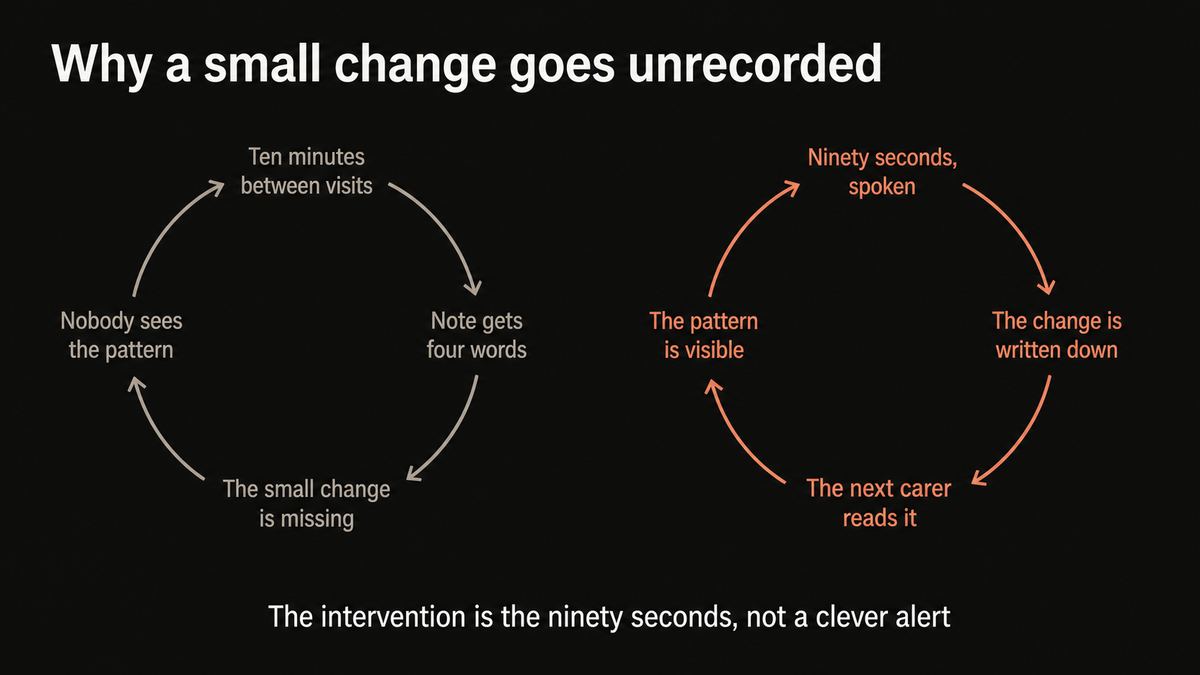
The classic version is a small change nobody recorded. Slightly less steady on Tuesday. Ate half a lunch on Wednesday. A bit muddled about the day on Thursday. Each one is unremarkable alone, and together they are a pattern that should have prompted something. If none of them made it into a note because each carer had nine minutes, the pattern does not exist anywhere except in three people's memories.
Lowering the cost of writing a note is the whole intervention. Not a clever alert system, not risk scoring. Just making it fast enough that the small observation gets recorded rather than dropped.
That is also why the fourth prompt matters most. "What does the next person need to know" turns a note from a record into a message.
À qui cela correspond
Home care and domiciliary workers doing multiple visits a day with travel between them. The car is the office and the ten minutes between calls is the whole window.
Support workers in supported living and community settings, where notes are written on the move.
Care home staff at handover, particularly where the concrete building means the wifi does not reach the far end of a corridor.
Nurses doing community rounds, though hospital nursing has a different shape and we wrote about that separately in AI for nurses.
Anyone supervising a team who is tired of chasing notes that were never written because there was no time.
Ce qu'il ne fait pas
No care plans or medication records. It does not hold a care plan, a MAR chart, a rota, or a risk assessment. Not a care management system.
No clinical alerts or scoring. It will not flag a deterioration, calculate a risk score, or suggest an action. It writes down what you say and nothing more, which is deliberate: a tool that appeared to make clinical judgements would be dangerous in this setting.
No integration with care records systems. There is no connection to any electronic care records platform, so getting text across means copying it. That is a genuine limitation.
No regulatory certification. Yaps is not a medical device, is not certified against any care-sector standard, and makes no compliance claim. Your organisation's data protection lead is the right person to approve any tool that touches information about people you support.
| What matters | Yaps | Typing into the care system | Cloud dictation apps |
|---|---|---|---|
| Works with no signal | Yes | Usually needs a connection | No |
| Nothing about the person uploaded | Yes, on device | Goes to your provider | No, sent to a vendor |
| Time per note | About 90 seconds spoken | Several minutes typed | Fast when it connects |
| Cleans up filler and punctuation | Yes | You type it properly | Varies |
| Is the official record | No, a capture tool | Yes | No |
| Holds care plans and MAR charts | No | Yes | No |
| Multilingual for a diverse workforce | About 25, auto-detected | Usually English only | Often, set manually |
A note on the multilingual point, because it matters more in care than in most sectors. A large share of care staff in the UK and elsewhere speak English as a second language, and writing detailed notes in a second language under time pressure is genuinely hard in a way that speaking them is not. Dictation covers about 25 languages and detects which one you are using, so a carer can speak in whichever language they are fastest in and then translate or re-enter as their employer requires. That is not a substitute for records in the required language, but it is a better starting point than a rushed paragraph.
La version courte
Care notes fail because of the conditions they are written in, not because carers do not care. Ten minutes, cold hands, one bar of signal, six visits left.
Speak the note in the car before you drive off, covering what you did, what changed, what concerned you, and what the next person needs to know. Use initials rather than full names. Then transfer it into whatever record your employer requires, because this is a capture tool and that is still the official record.
Install Yaps on Android and prove it works with mobile data off before you rely on it. Check your employer's policy on personal devices first. It holds no care plans, makes no clinical judgements, and connects to no care records system, and those limits are worth knowing going in.
Foire aux questions
Is there a care notes app that works without signal?
Yes. Yaps runs speech recognition on the phone itself, so you can dictate a visit note in a basement flat, a stairwell, or a rural lane with no bars at all. This is the main practical reason to prefer on-device dictation for care work: cloud tools fail exactly where the visits are, and they often fail quietly so you believe the note was written. Verify it by switching off mobile data and dictating a sentence.
Does this replace our care management system?
No. It holds no care plans, no medication administration records, no rotas, and no risk assessments, and it does not connect to any electronic care records platform. It is a capture tool: it gets what happened out of your head into readable text quickly, so what you then enter into the official system is complete rather than rushed. Your employer's system remains the record.
Can I put notes about someone I support on my own phone?
Check your employer's policy first, because many care organisations have specific rules about personal devices and some prohibit it outright. If it is permitted, keep identifying detail to a minimum, use initials rather than full names, and make sure the phone has a screen lock and device encryption. Your organisation's data protection lead is the right person to approve any tool that touches this information.
How long does a spoken visit note take?
About ninety seconds, against several minutes typed with thumbs on a phone. The bigger gain is accuracy rather than time: a note dictated outside the house is exact, and one written at the end of an eight-visit day is a reconstruction that blurs the visits together.
What should a good care visit note include?
Four things. What you did, plainly. What changed compared with last time, which is the most important line because change is the signal. Anything that concerned you, even if you are unsure. And what the next person needs to know before they knock. That last prompt turns a note from a record into a handover.
Does it flag concerns or score risk automatically?
No, deliberately. There is no alerting, no risk scoring, and no suggestion about anyone's care. It writes down what you say. A tool that appeared to make clinical judgements would be dangerous in this setting, and writing a concern in a note is never a substitute for following your employer's escalation process.
Is it suitable if English is not my first language?
That is one of the better reasons to use it. Dictation covers about 25 languages and detects which one you are speaking rather than making you choose from a menu, so you can speak in whichever language you are fastest in. Writing detailed notes in a second language under time pressure is genuinely hard in a way that speaking is not. You will still need the record in whatever language your employer requires.
Is Yaps certified for use in health and social care?
No. It is not a medical device, holds no care-sector certification, and makes no compliance claim. What it offers instead is that information about the person you support is not transmitted anywhere when you work offline, which is a different position from a cloud tool operating under a contract. Any tool touching this data should go through your organisation's approval process.
Can a whole care team share notes through it?
No. There is no shared workspace, no permissions model, and no team view, so it does not work as a handover system for a team. Handover still happens through your employer's system. Individual carers use this to write better notes faster before entering them there.
Does it work on a work phone as well as a personal one?
Yes, and the same policy questions apply either way. Yaps runs on Android, with a free tier covering voice typing, voice notes, and read-aloud on the device. An iPhone and iPad version is coming soon, so for now the mobile half is Android.
What does it cost?
There is a free tier on Android covering voice typing, voice notes, and read-aloud on the device, which is the part relevant to writing notes on a round. Desktop is separate, with a 7-day free trial and then Pro at $15 a month or Max at $25.
Can it read notes back to me?
Yes. Read-aloud can play a note back, which some people use to check a note says what they meant before transferring it, and which helps if reading a screen in a car in poor light is difficult. On Android that is the two mobile voices; desktop has 18 with 8 running offline.